Advantages of Xymon vs Nagios?
list Andrew Rakowski
I've been using Big Brother since 1999, and Xymon for the last couple of years (on a different project at the lab), but recently, a team member has suggested that we switch infrastructure monitoring to Nagios, which he's been using on other systems he manages elsewhere in the lab.

He's using something called OMD (the Open Monitoring Distribution - from http://omdistro.org/ ), which is supposed to improve on the complexity of using Nagios.  Our management would like us to do a comparison to see if we should switch from our old Big Brother monitoring (which is still running well) to a more up to date Xymon or convert instead to OMD/Nagios.

Looking for information on Xymon and Nagios comparisons, I found this comment from Henrik in the Xymon mailing list archive:

     http://lists.xymon.com/archive/2006-June/007530.html

that mentions the ease of setup and use of Xymon as compared to Nagios, but that comment is nine years old.

Daniel's recent comments on this list about wanting to move from Nagios to Xymon:

On Fri, 6 Feb 2015, LOZOVSKY, DANIEL L wrote (in part):
Subject: Re: [Xymon] Installing xymon/apache as a non-root user
[...snip...]
community. I have been pushing AT&T to utilize xymon instead of nagios. I have been using BB open source version for almost 10 years and it really saved us at Supply Chain. Of course, I had to make a lot of modifications to it. Xymon is the next logical step to help make things much better.
[...snip...]

has me wondering what I can point to as good reasons to use Xymon vs Nagios, as certainly, people do want to switch.

So, what are reasons that folks like Xymon better than Nagios (besides all the helpful info from the great group of folks I've been reading during my years of lurking on the list...)?

Best regards,

-Andrew
list Daniel L Lozovsky
I can tell you this much.  I engaged a nagios team at AT&T at the request of my management.  After showing the nagios SMEs what I needed to do in order to monitor the worlds biggest oracle e-business ERP implantation, the nagios SME told me that I would need to implement a farm of nagios servers to do the same that I am doing with my modified BB one solaris server.  Right now with BB that is running on a 16 year old solaris server, I am monitoring server health, Oracle db health, network and complex internal Supply Chain logic.

Nagios is a decent product, just does not work for what we need to do at supply chain.
Sent from my iPhone
▸
On Feb 8, 2015, at 6:36 PM, Andrew Rakowski <user-00c59fc5f1d5@xymon.invalid> wrote:

I've been using Big Brother since 1999, and Xymon for the last couple of years (on a different project at the lab), but recently, a team member has suggested that we switch infrastructure monitoring to Nagios, which he's been using on other systems he manages elsewhere in the lab.

He's using something called OMD (the Open Monitoring Distribution - from http://omdistro.org/ ), which is supposed to improve on the complexity of using Nagios.  Our management would like us to do a comparison to see if we should switch from our old Big Brother monitoring (which is still running well) to a more up to date Xymon or convert instead to OMD/Nagios.

Looking for information on Xymon and Nagios comparisons, I found this comment from Henrik in the Xymon mailing list archive:

   http://lists.xymon.com/archive/2006-June/007530.html

that mentions the ease of setup and use of Xymon as compared to Nagios, but that comment is nine years old.

Daniel's recent comments on this list about wanting to move from Nagios to Xymon:

On Fri, 6 Feb 2015, LOZOVSKY, DANIEL L wrote (in part):
Subject: Re: [Xymon] Installing xymon/apache as a non-root user[...snip...]community. I have been pushing AT&T to utilize xymon instead of nagios. I have been using BB open source version for almost 10 years and it really saved us at Supply Chain. Of course, I had to make a lot of modifications to it. Xymon is the next logical step to help make things much better.[...snip...] has me wondering what I can point to as good reasons to use Xymon vs Nagios, as certainly, people do want to switch. So, what are reasons that folks like Xymon better than Nagios (besides all the helpful info from the great group of folks I've been reading during my years of lurking on the list...)? Best regards, -Andrew
list Olivier Audry
hello

I think your answer is in your question : 'which is supposed to improve on the complexity of using Nagios'. Nagios is horribly complex and heavy as xymon is simple light extensible and elegant. I'm monitore around 25 000 devices (from telco layer 2 and 3 , os, vmware to apps ) without any pb with a team of 2 and a half people. So you can maintain easily xymon.

oau
▸
Le lun. 9 févr. 2015 à 4:35, LOZOVSKY, DANIEL L <user-5085da3588ee@xymon.invalid> a écrit :I can tell you this much. I engaged a nagios team at AT&T at the request of my management. After showing the nagios SMEs what I needed to do in order to monitor the worlds biggest oracle e-business ERP implantation, the nagios SME told me that I would need to implement a farm of nagios servers to do the same that I am doing with my modified BB one solaris server. Right now with BB that is running on a 16 year old solaris server, I am monitoring server health, Oracle db health, network and complex internal Supply Chain logic. Nagios is a decent product, just does not work for what we need to do at supply chain. Sent from my iPhoneOn Feb 8, 2015, at 6:36 PM, Andrew Rakowski <user-00c59fc5f1d5@xymon.invalid> wrote: I've been using Big Brother since 1999, and Xymon for the last couple of years (on a different project at the lab), but recently, a team member has suggested that we switch infrastructure monitoring to Nagios, which he's been using on other systems he manages elsewhere in the lab. He's using something called OMD (the Open Monitoring Distribution - from http://omdistro.org/ ), which is supposed to improve on the complexity of using Nagios. Our management would like us to do a comparison to see if we should switch from our old Big Brother monitoring (which is still running well) to a more up to date Xymon or convert instead to OMD/Nagios. Looking for information on Xymon and Nagios comparisons, I found this comment from Henrik in the Xymon mailing list archive: http://lists.xymon.com/archive/2006-June/007530.html that mentions the ease of setup and use of Xymon as compared to Nagios, but that comment is nine years old. Daniel's recent comments on this list about wanting to move from Nagios to Xymon: On Fri, 6 Feb 2015, LOZOVSKY, DANIEL L wrote (in part):Subject: Re: [Xymon] Installing xymon/apache as a non-root user[...snip...]community. I have been pushing AT&T to utilize xymon instead of nagios. I have been using BB open source version for almost 10 years and it really saved us at Supply Chain. Of course, I had to make a lot of modifications to it. Xymon is the next logical step to help make things much better.[...snip...] has me wondering what I can point to as good reasons to use Xymon vs Nagios, as certainly, people do want to switch. So, what are reasons that folks like Xymon better than Nagios (besides all the helpful info from the great group of folks I've been reading during my years of lurking on the list...)? Best regards, -Andrew
list Michael Resnick
I have almost completely phased out nagios. I work at a financial services Company and security is one of our top concerns.Having the agents send to the server and not having to open any additional ports is a big plus.
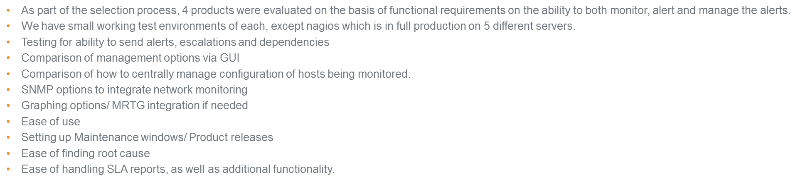
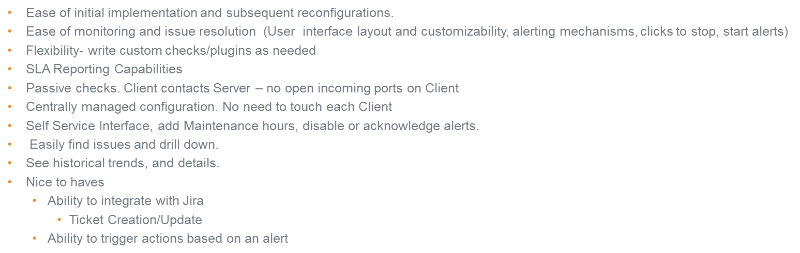
I put together a powerpoint presentation for management explaining why I wanted to move to xymon, and after looking at alternatives.
here are some of the text portions


opsView -
OMD -

HTH
Attachments (4)
 attachment.png
 attachment-0003.png
 attachment-0005.png
 attachment-0010.png
list Vernon Everett
For me, the choice was made about 10 years ago, when I was looking for a
monitoring tool.
I had seen Big Brother, but the license had just changed, and it was now
commercial.
Management weren't prepared to fork out a dime.
So I compared a few products, and the product now known as Xymon was the
only free open source product that did graphing out of the box. I wanted
graphing. PHBs love graphs. :-)
It was also far simpler than anything else to configure and get running.

And once I figured out how to write extension scripts, there was no looking
back.
We need to look to Da Vinci for inspiration here. He is reported to have
once said, "Simplicity is the ultimate sophistication".
By that measure, Xymon is the most sophisticated monitoring tool out there.

I have used Nagios, What's-Up Gold, SCOM (hehehehe), Cacti, Zabbix, and
Solarwinds.
While some, can monitor certain things better than others, I believe that
for the Unix/Linux environment, there is nothing to compare to Xymon.
And, if we look at how it stands up in other areas (like Wintendo), it's
pretty impressive.

Try something.
Identify something arbitrary, that can be graphed, and monitored. Like
perhaps memory utilisation of a specific process, or highest process ID at
the moment.
It doesn't need to be meaningful, just doable.
Now see who can get it onto a monitoring screen, with graphing, first.

Be gracious when you win though. :-)

Regards
Vernon
▸
On 9 February 2015 at 09:36, Andrew Rakowski <user-00c59fc5f1d5@xymon.invalid> wrote:
I've been using Big Brother since 1999, and Xymon for the last couple of
years (on a different project at the lab), but recently, a team member has
suggested that we switch infrastructure monitoring to Nagios, which he's
been using on other systems he manages elsewhere in the lab.

He's using something called OMD (the Open Monitoring Distribution - from
http://omdistro.org/ ), which is supposed to improve on the complexity of
using Nagios.  Our management would like us to do a comparison to see if we
should switch from our old Big Brother monitoring (which is still running
well) to a more up to date Xymon or convert instead to OMD/Nagios.

Looking for information on Xymon and Nagios comparisons, I found this
comment from Henrik in the Xymon mailing list archive:

    http://lists.xymon.com/archive/2006-June/007530.html

that mentions the ease of setup and use of Xymon as compared to Nagios,
but that comment is nine years old.

Daniel's recent comments on this list about wanting to move from Nagios to
Xymon:

On Fri, 6 Feb 2015, LOZOVSKY, DANIEL L wrote (in part):
Subject: Re: [Xymon] Installing xymon/apache as a non-root user [...snip...]community. I have been pushing AT&T to utilize xymon instead of nagios. I have been using BB open source version for almost 10 years and it really saved us at Supply Chain. Of course, I had to make a lot of modifications to it. Xymon is the next logical step to help make things much better.[...snip...] has me wondering what I can point to as good reasons to use Xymon vs Nagios, as certainly, people do want to switch. So, what are reasons that folks like Xymon better than Nagios (besides all the helpful info from the great group of folks I've been reading during my years of lurking on the list...)? Best regards, -Andrew
--
"Accept the challenges so that you can feel the exhilaration of victory"
- General George Patton
list Mark Felder
▸
On Sun, Feb 8, 2015, at 19:36, Andrew Rakowski wrote:
I've been using Big Brother since 1999, and Xymon for the last couple of
years (on a different project at the lab), but recently, a team member
has
suggested that we switch infrastructure monitoring to Nagios, which he's
been using on other systems he manages elsewhere in the lab.
Why? What is broken or deficient with your current Xymon implementation?
If there isn't an answer other than familiarity you're going down a
dangerous path. Is your existing monitoring reliable? If so, then keep
it. Changing monitoring systems and not knowing how it will behave is
not fun.

Xymon tends to win for me because I don't run large homogenous systems.
If I had 3000 servers that all had identical services being monitored
Nagios will work pretty well -- create your rulesets, put all 3000
servers in the group.

If you have a lot of heterogeneous systems to monitor Xymon will win
every time in its simplicity for setup and maintainability. Plus you
don't need to configure the client any further than telling it what the
Xymon server's IP is, unless you're adding additional monitoring
scripts.

It doesn't matter what you wrap Nagios in, it's still Nagios underneath
and has the same problems. You're just expecting yet another layer of
complexity to solve them for you.
list Ralph Mitchell
About 5 years ago I started a new job at a company that had very little
monitoring set up.  I knew we'd need something, and I wanted that to be
Xymon, but Nagios would have been an easier choice because it was supplied
with the Linux distro we were using.  I got some stuff working, but then
there were mysterious failures - clients just stopped checking in with the
server for no good reason.  Every network test I tried from client to
server worked every time, but Nagios simply wouldn't connect.  I had to
cobble together some scripts to deliver reports.

Also, while I agree this may just be a misinterpretation, it felt to me as
if each Nagios installation wanted to be standalone.  Sure, it would
receive reports from other Nagios clients and make up pages to display, but
it seemed complicated to configure it to talk to anyone else.

Also also, graphing was a bolt-on extra.  I think I didn't have the correct
patchlevel for some prerequisites, so I had to manually upgrade $DEPENDENCY
and subsequently maintain that package forever.

Does Nagios have the equivalent of xymondboard?  I've written a number of
cgi scripts recently to query the reports from 1600 theoretically identical
machines and display the results as both a web page and a daily report
email.  This saves the app admins some time and gives upper management a
quick look at the state of the enterprise.

Ralph Mitchell


On Mon, Feb 9, 2015 at 8:08 AM, Vernon Everett <user-b3f8dacb72c8@xymon.invalid>
▸
wrote:
For me, the choice was made about 10 years ago, when I was looking for a
monitoring tool.
I had seen Big Brother, but the license had just changed, and it was now
commercial.
Management weren't prepared to fork out a dime.
So I compared a few products, and the product now known as Xymon was the
only free open source product that did graphing out of the box. I wanted
graphing. PHBs love graphs. :-)
It was also far simpler than anything else to configure and get running.

And once I figured out how to write extension scripts, there was no
looking back.
We need to look to Da Vinci for inspiration here. He is reported to have
once said, "Simplicity is the ultimate sophistication".
By that measure, Xymon is the most sophisticated monitoring tool out there.

I have used Nagios, What's-Up Gold, SCOM (hehehehe), Cacti, Zabbix, and
Solarwinds.
While some, can monitor certain things better than others, I believe that
for the Unix/Linux environment, there is nothing to compare to Xymon.
And, if we look at how it stands up in other areas (like Wintendo), it's
pretty impressive.

Try something.
Identify something arbitrary, that can be graphed, and monitored. Like
perhaps memory utilisation of a specific process, or highest process ID at
the moment.
It doesn't need to be meaningful, just doable.
Now see who can get it onto a monitoring screen, with graphing, first.

Be gracious when you win though. :-)

Regards
Vernon


On 9 February 2015 at 09:36, Andrew Rakowski <user-00c59fc5f1d5@xymon.invalid> wrote:
I've been using Big Brother since 1999, and Xymon for the last couple of years (on a different project at the lab), but recently, a team member has suggested that we switch infrastructure monitoring to Nagios, which he's been using on other systems he manages elsewhere in the lab. He's using something called OMD (the Open Monitoring Distribution - from http://omdistro.org/ ), which is supposed to improve on the complexity of using Nagios. Our management would like us to do a comparison to see if we should switch from our old Big Brother monitoring (which is still running well) to a more up to date Xymon or convert instead to OMD/Nagios. Looking for information on Xymon and Nagios comparisons, I found this comment from Henrik in the Xymon mailing list archive: http://lists.xymon.com/archive/2006-June/007530.html that mentions the ease of setup and use of Xymon as compared to Nagios, but that comment is nine years old. Daniel's recent comments on this list about wanting to move from Nagios to Xymon: On Fri, 6 Feb 2015, LOZOVSKY, DANIEL L wrote (in part):Subject: Re: [Xymon] Installing xymon/apache as a non-root user [...snip...]community. I have been pushing AT&T to utilize xymon instead of nagios. I have been using BB open source version for almost 10 years and it really saved us at Supply Chain. Of course, I had to make a lot of modifications to it. Xymon is the next logical step to help make things much better.[...snip...] has me wondering what I can point to as good reasons to use Xymon vs Nagios, as certainly, people do want to switch. So, what are reasons that folks like Xymon better than Nagios (besides all the helpful info from the great group of folks I've been reading during my years of lurking on the list...)? Best regards, -Andrew-- "Accept the challenges so that you can feel the exhilaration of victory" - General George Patton
list Simeon Berkley
I recently switched from an environment that was Xymon-monitored to a smaller one that used Nagios at a different job. After giving their existing Nagios installation a chance and attempting to get it to do the things that Xymon does out-of-the-box (graphing mainly), I prefer Xymon. I did enjoy the oo design of Nagios' config files, though I ran into some weird precedence issues that weren't adequately explained by the documentation I had, which included a decent Nagios book. I've never needed a book for Xymon, the man pages that come with it are sufficient and the community helpful. Now I'm back at the previous job, using Xymon again. The only thing I could say I miss about Nagios is the flexibility/extensibility of the configuration, though that could get more than a little annoying to debug. The two graphing solutions that I tried for Nagios never quite worked, were hard to debug, and didn't seem to have an active user community. -- Simeon Berkley Senior Systems Engineer McClatchy Interactive
▸
On Mon, Feb 9, 2015 at 9:23 AM, Ralph Mitchell <user-00a5e44c48c0@xymon.invalid> wrote:About 5 years ago I started a new job at a company that had very little monitoring set up. I knew we'd need something, and I wanted that to be Xymon, but Nagios would have been an easier choice because it was supplied with the Linux distro we were using. I got some stuff working, but then there were mysterious failures - clients just stopped checking in with the server for no good reason. Every network test I tried from client to server worked every time, but Nagios simply wouldn't connect. I had to cobble together some scripts to deliver reports. Also, while I agree this may just be a misinterpretation, it felt to me as if each Nagios installation wanted to be standalone. Sure, it would receive reports from other Nagios clients and make up pages to display, but it seemed complicated to configure it to talk to anyone else. Also also, graphing was a bolt-on extra. I think I didn't have the correct patchlevel for some prerequisites, so I had to manually upgrade $DEPENDENCY and subsequently maintain that package forever. Does Nagios have the equivalent of xymondboard? I've written a number of cgi scripts recently to query the reports from 1600 theoretically identical machines and display the results as both a web page and a daily report email. This saves the app admins some time and gives upper management a quick look at the state of the enterprise. Ralph Mitchell On Mon, Feb 9, 2015 at 8:08 AM, Vernon Everett <user-b3f8dacb72c8@xymon.invalid> wrote:For me, the choice was made about 10 years ago, when I was looking for a monitoring tool. I had seen Big Brother, but the license had just changed, and it was now commercial. Management weren't prepared to fork out a dime. So I compared a few products, and the product now known as Xymon was the only free open source product that did graphing out of the box. I wanted graphing. PHBs love graphs. :-) It was also far simpler than anything else to configure and get running. And once I figured out how to write extension scripts, there was no looking back. We need to look to Da Vinci for inspiration here. He is reported to have once said, "Simplicity is the ultimate sophistication". By that measure, Xymon is the most sophisticated monitoring tool out there. I have used Nagios, What's-Up Gold, SCOM (hehehehe), Cacti, Zabbix, and Solarwinds. While some, can monitor certain things better than others, I believe that for the Unix/Linux environment, there is nothing to compare to Xymon. And, if we look at how it stands up in other areas (like Wintendo), it's pretty impressive. Try something. Identify something arbitrary, that can be graphed, and monitored. Like perhaps memory utilisation of a specific process, or highest process ID at the moment. It doesn't need to be meaningful, just doable. Now see who can get it onto a monitoring screen, with graphing, first. Be gracious when you win though. :-) Regards Vernon On 9 February 2015 at 09:36, Andrew Rakowski <user-00c59fc5f1d5@xymon.invalid> wrote:I've been using Big Brother since 1999, and Xymon for the last couple of years (on a different project at the lab), but recently, a team member has suggested that we switch infrastructure monitoring to Nagios, which he's been using on other systems he manages elsewhere in the lab. He's using something called OMD (the Open Monitoring Distribution - from http://omdistro.org/ ), which is supposed to improve on the complexity of using Nagios. Our management would like us to do a comparison to see if we should switch from our old Big Brother monitoring (which is still running well) to a more up to date Xymon or convert instead to OMD/Nagios. Looking for information on Xymon and Nagios comparisons, I found this comment from Henrik in the Xymon mailing list archive: http://lists.xymon.com/archive/2006-June/007530.html that mentions the ease of setup and use of Xymon as compared to Nagios, but that comment is nine years old. Daniel's recent comments on this list about wanting to move from Nagios to Xymon: On Fri, 6 Feb 2015, LOZOVSKY, DANIEL L wrote (in part):Subject: Re: [Xymon] Installing xymon/apache as a non-root user[...snip...]community. I have been pushing AT&T to utilize xymon instead of nagios. I have been using BB open source version for almost 10 years and it really saved us at Supply Chain. Of course, I had to make a lot of modifications to it. Xymon is the next logical step to help make things much better.[...snip...] has me wondering what I can point to as good reasons to use Xymon vs Nagios, as certainly, people do want to switch. So, what are reasons that folks like Xymon better than Nagios (besides all the helpful info from the great group of folks I've been reading during my years of lurking on the list...)? Best regards, -Andrew-- "Accept the challenges so that you can feel the exhilaration of victory" - General George Patton
list Sue Bauer-Lee
I'' add that I've always preferred the 'cleanliness' of the xymon interface for large organizations. unless things have changed drastically, I found Nagios cumbersome to navigate with more than a handful of hosts.
▸
-----Original Message-----
From: Xymon [mailto:xymon-bounces at xymon.com] On Behalf Of Berkley, Simeon
Sent: Monday, February 09, 2015 9:21 AM
To: xymon at xymon.com
Subject: Re: [Xymon] Advantages of Xymon vs Nagios?
I recently switched from an environment that was Xymon-monitored to a smaller one that used Nagios at a different job. After giving their existing Nagios installation a chance and attempting to get it to do the things that Xymon does out-of-the-box (graphing mainly), I prefer Xymon. I did enjoy the oo design of Nagios' config files, though I ran into some weird precedence issues that weren't adequately explained by the documentation I had, which included a decent Nagios book. I've never needed a book for Xymon, the man pages that come with it are sufficient and the community helpful.
Now I'm back at the previous job, using Xymon again. The only thing I could say I miss about Nagios is the flexibility/extensibility of the configuration, though that could get more than a little annoying to debug. The two graphing solutions that I tried for Nagios never quite worked, were hard to debug, and didn't seem to have an active user community.
--
Simeon Berkley
Senior Systems Engineer
McClatchy Interactive
On Mon, Feb 9, 2015 at 9:23 AM, Ralph Mitchell <user-00a5e44c48c0@xymon.invalid> wrote:About 5 years ago I started a new job at a company that had very little monitoring set up. I knew we'd need something, and I wanted that to be Xymon, but Nagios would have been an easier choice because it was supplied with the Linux distro we were using. I got some stuff working, but then there were mysterious failures - clients just stopped checking in with the server for no good reason. Every network test I tried from client to server worked every time, but Nagios simply wouldn't connect. I had to cobble together some scripts to deliver reports. Also, while I agree this may just be a misinterpretation, it felt to me as if each Nagios installation wanted to be standalone. Sure, it would receive reports from other Nagios clients and make up pages to display, but it seemed complicated to configure it to talk to anyone else. Also also, graphing was a bolt-on extra. I think I didn't have the correct patchlevel for some prerequisites, so I had to manually upgrade $DEPENDENCY and subsequently maintain that package forever. Does Nagios have the equivalent of xymondboard? I've written a number of cgi scripts recently to query the reports from 1600 theoretically identical machines and display the results as both a web page and a daily report email. This saves the app admins some time and gives upper management a quick look at the state of the enterprise. Ralph Mitchell On Mon, Feb 9, 2015 at 8:08 AM, Vernon Everett <user-b3f8dacb72c8@xymon.invalid> wrote:For me, the choice was made about 10 years ago, when I was looking for a monitoring tool. I had seen Big Brother, but the license had just changed, and it was now commercial. Management weren't prepared to fork out a dime. So I compared a few products, and the product now known as Xymon was the only free open source product that did graphing out of the box. I wanted graphing. PHBs love graphs. :-) It was also far simpler than anything else to configure and get running. And once I figured out how to write extension scripts, there was no looking back. We need to look to Da Vinci for inspiration here. He is reported to have once said, "Simplicity is the ultimate sophistication". By that measure, Xymon is the most sophisticated monitoring tool out there. I have used Nagios, What's-Up Gold, SCOM (hehehehe), Cacti, Zabbix, and Solarwinds. While some, can monitor certain things better than others, I believe that for the Unix/Linux environment, there is nothing to compare to Xymon. And, if we look at how it stands up in other areas (like Wintendo), it's pretty impressive. Try something. Identify something arbitrary, that can be graphed, and monitored. Like perhaps memory utilisation of a specific process, or highest process ID at the moment. It doesn't need to be meaningful, just doable. Now see who can get it onto a monitoring screen, with graphing, first. Be gracious when you win though. :-) Regards Vernon On 9 February 2015 at 09:36, Andrew Rakowski <user-00c59fc5f1d5@xymon.invalid> wrote:I've been using Big Brother since 1999, and Xymon for the last couple of years (on a different project at the lab), but recently, a team member has suggested that we switch infrastructure monitoring to Nagios, which he's been using on other systems he manages elsewhere in the lab. He's using something called OMD (the Open Monitoring Distribution - from http://omdistro.org/ ), which is supposed to improve on the complexity of using Nagios. Our management would like us to do a comparison to see if we should switch from our old Big Brother monitoring (which is still running well) to a more up to date Xymon or convert instead to OMD/Nagios. Looking for information on Xymon and Nagios comparisons, I found this comment from Henrik in the Xymon mailing list archive: http://lists.xymon.com/archive/2006-June/007530.html that mentions the ease of setup and use of Xymon as compared to Nagios, but that comment is nine years old. Daniel's recent comments on this list about wanting to move from Nagios to Xymon: On Fri, 6 Feb 2015, LOZOVSKY, DANIEL L wrote (in part):Subject: Re: [Xymon] Installing xymon/apache as a non-root user[...snip...]community. I have been pushing AT&T to utilize xymon instead of nagios. I have been using BB open source version for almost 10 years and it really saved us at Supply Chain. Of course, I had to make a lot of modifications to it. Xymon is the next logical step to help make things much better.[...snip...] has me wondering what I can point to as good reasons to use Xymon vs Nagios, as certainly, people do want to switch. So, what are reasons that folks like Xymon better than Nagios (besides all the helpful info from the great group of folks I've been reading during my years of lurking on the list...)? Best regards, -Andrew-- "Accept the challenges so that you can feel the exhilaration of victory" - General George Patton
This email has been scanned by the Symantec Email Security.cloud service. For more information please visit http://www.symanteccloud.com ______________________________________________________________________ NOTICE OF CONFIDENTIALITY: This message and any attachments contains confidential information belonging to the sender intended only for the use of the individual or entity named above. If you are not the intended recipient, be advised that copying, disclosure or reliance upon the contents is strictly prohibited. If you have received this message in error please notify the sender immediately. This email has been scanned by the Symantec Email Security.cloud service. For more information please visit http://www.symanteccloud.com
list Nikolai Lifanov
▸
On 02/08/15 20:36, Andrew Rakowski wrote:
I've been using Big Brother since 1999, and Xymon for the last couple of
years (on a different project at the lab), but recently, a team member has
suggested that we switch infrastructure monitoring to Nagios, which he's
been using on other systems he manages elsewhere in the lab.

He's using something called OMD (the Open Monitoring Distribution - from
http://omdistro.org/ ), which is supposed to improve on the complexity
of using Nagios.  Our management would like us to do a comparison to see if
we should switch from our old Big Brother monitoring (which is still
running well) to a more up to date Xymon or convert instead to OMD/Nagios.

Looking for information on Xymon and Nagios comparisons, I found this
comment from Henrik in the Xymon mailing list archive:

    http://lists.xymon.com/archive/2006-June/007530.html

that mentions the ease of setup and use of Xymon as compared to Nagios,
but that comment is nine years old.

Daniel's recent comments on this list about wanting to move from Nagios
to Xymon:

On Fri, 6 Feb 2015, LOZOVSKY, DANIEL L wrote (in part):
Subject: Re: [Xymon] Installing xymon/apache as a non-root user[...snip...]community. I have been pushing AT&T to utilize xymon instead of nagios. I have been using BB open source version for almost 10 years and it really saved us at Supply Chain. Of course, I had to make a lot of modifications to it. Xymon is the next logical step to help make things much better.[...snip...] has me wondering what I can point to as good reasons to use Xymon vs Nagios, as certainly, people do want to switch. So, what are reasons that folks like Xymon better than Nagios (besides all the helpful info from the great group of folks I've been reading during my years of lurking on the list...)? Best regards, -Andrew
For the sake of good investigation, I would ask the same question on
Nagios MLs as well. You will find that people here tend to have positive
things to say about Xymon.

- Nikolai Lifanov
list Sean MacGuire
OK, I'll chime in since I know a little about Big Brother.

Let's divide it up into different areas.  I don't know much about
Nagios, so someone else will have to chime in.


What problem are you trying to solve?

This may not be as straightforward as it appears.  Maybe the boss
wants to keep an eye on stuff as well.  Maybe politically new people
want a new thing, or a majority of people already know one or the
other system.  That stuff will really be key in what gets used.

Xymon / BB is great for publishing system information in a manner
that mere mortals and bosses can consume.  You can beat red/yellow/
green and purple(!) on a grid for a fast overview, or for putting up
on a big screen in a NOC.  So a quick test is give both screens to
your management and let them ponder it.

A downside of that is the Xymon / BB interface looks old.  I mean
'party like it's 1999 old'.  That's probably one of the biggest things
against it.  A new skin would help a great deal here since the
underlying testing of stuff is pretty well the same.

How much custom stuff do you have in the environment already running,
and how long is it going to take to get it replicated in the new
environment?

Ditto notification systems, failover, etc.

Ultimately, how much do I trust each of these systems to tell me
when there's something wrong.  These things are going to wake me up
in the middle of the night... and people depend on the systems they
monitor.  So who do you want in the admin foxhole with you?  It takes
time to develop a level of proficiency and trust in a system...

The quick answer is 'let's spin one up and compare apples to apples'.
At the end of the exercise, it should be clearer what the costs will
be.

[And of course, if the answer is 'Nagios' you can leave Xymon/BB running
very quietly in the background to save your ass].
▸
Nikolai Lifanov wrote:On 02/08/15 20:36, Andrew Rakowski wrote:I've been using Big Brother since 1999, and Xymon for the last couple of years (on a different project at the lab), but recently, a team member has suggested that we switch infrastructure monitoring to Nagios, which he's been using on other systems he manages elsewhere in the lab. He's using something called OMD (the Open Monitoring Distribution - from http://omdistro.org/ ), which is supposed to improve on the complexity of using Nagios. Our management would like us to do a comparison to see if we should switch from our old Big Brother monitoring (which is still running well) to a more up to date Xymon or convert instead to OMD/Nagios. Looking for information on Xymon and Nagios comparisons, I found this comment from Henrik in the Xymon mailing list archive: http://lists.xymon.com/archive/2006-June/007530.html that mentions the ease of setup and use of Xymon as compared to Nagios, but that comment is nine years old. Daniel's recent comments on this list about wanting to move from Nagios to Xymon: On Fri, 6 Feb 2015, LOZOVSKY, DANIEL L wrote (in part):Subject: Re: [Xymon] Installing xymon/apache as a non-root user[...snip...]community. I have been pushing AT&T to utilize xymon instead of nagios. I have been using BB open source version for almost 10 years and it really saved us at Supply Chain. Of course, I had to make a lot of modifications to it. Xymon is the next logical step to help make things much better.[...snip...] has me wondering what I can point to as good reasons to use Xymon vs Nagios, as certainly, people do want to switch. So, what are reasons that folks like Xymon better than Nagios (besides all the helpful info from the great group of folks I've been reading during my years of lurking on the list...)? Best regards, -AndrewFor the sake of good investigation, I would ask the same question on Nagios MLs as well. You will find that people here tend to have positive things to say about Xymon. - Nikolai Lifanov
--
Sean MacGuire                                 user-4915795a2617@xymon.invalid

Key West                                        +X XXX XXX XXXX
The best way to predict the future is to invent it. -  Alan Kay
list Andrew Rakowski
I don't want to add noise to the list, but did want to thank all the folks that took the time to comment on the use of Xymon vs Nagios.  To add some signal to this post, you can find the thread of responses in the list archive starting at:

     http://lists.xymon.com/archive/2015-February/thread.html#41023

Thanks everyone!

-Andrew


On Sun, 8 Feb 2015, Andrew Rakowski wrote (in small part):
[...snip...]
▸
So, what are reasons that folks like Xymon better than Nagios (besides all the helpful info from the great group of folks I've been reading during my years of lurking on the list...)?